- No products in the cart.























 FREE SHIPPING
CNC Revolving Live Centers vs. Dead Centers: Key Differences Explained


29
Jan
Introduction
When it comes to CNC turning operations, choosing the right work-holding tool is just as important as selecting cutting tools or machine settings. Two of the most commonly used tools for supporting a workpiece are the revolving live center and the dead center. Both are designed to stabilize and support the workpiece during machining, but they function very differently and are suited to different types of operations.
In this guide, we’ll explain what live centers and dead centers are, how they work, their advantages and disadvantages, and how to choose the best one for your CNC applications.
Understanding the Role of Centers in CNC Machining
During turning, especially when machining long or heavy workpieces, stability is critical. Without proper support, the workpiece can bend, vibrate, or deflect, leading to:
-
Poor surface finish
-
Dimensional inaccuracies
-
Reduced tool life
-
Increased scrap rates
To prevent these issues, machinists use centers in the tailstock of CNC lathes. The center keeps the workpiece aligned along its axis, ensuring it rotates smoothly and stays stable during cutting.
There are two main types of centers: Dead Centers (stationary) and Revolving Live Centers (rotating). Let’s look at each in detail.
What Is a Dead Center?
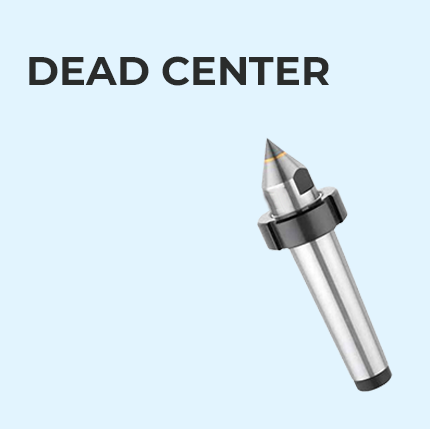
A dead center is the more traditional type of center. It’s a hardened steel (or carbide-tipped) tool with a pointed end that fits into the workpiece center hole. Unlike a live center, it does not rotate with the workpiece – it remains fixed in place.
Instead, the workpiece rotates against the stationary tip of the dead center.
Features of Dead Centers:
-
Made from hardened tool steel or carbide
-
Solid and highly rigid
-
Stationary (does not rotate)
-
Requires lubrication between the center tip and the workpiece hole to reduce friction
-
Can be used in both lathe tailstocks and grinding machines
Advantages of Dead Centers:
-
Extremely rigid and durable
-
Provides very high-dimensional accuracy
-
Excellent for low-speed turning and grinding
-
Low cost and easy to maintain
Limitations of Dead Centers:
-
Generates high friction and heat at higher speeds
-
Requires constant lubrication
-
Not suitable for modern high-speed CNC turning operations
What Is a Revolving Live Center?
A revolving live center is a more advanced tool. It has a pointed tip that rotates with the workpiece, thanks to precision bearings inside the body of the tool. This design drastically reduces friction and heat generation compared to a dead center.
Revolving live centers are available in different designs – standard, heavy-duty, carbide-tipped, and extended-nose – to suit various CNC applications.
Features of Revolving Live Centers:
-
Equipped with high-precision bearings
-
The tip rotates with the workpiece
-
Designed for high-speed operations
-
Provides smooth, stable support for long workpieces
-
Available in specialized designs for heavy loads, high RPMs, or special materials
Advantages of Revolving Live Centers:
-
Handles high-speed CNC turning with ease
-
Reduces friction, heat, and wear
-
Increases tool life and workpiece surface finish quality
-
Better suited for long, slender shafts and precision machining
-
Can handle both light-duty and heavy-duty operations, depending on the design
Limitations of Revolving Live Centers:
-
More expensive than dead centers
-
Bearings can wear out over time, requiring maintenance or replacement
-
Not as rigid as a solid dead center in ultra-precision grinding
Key Differences Between Dead Centers and Revolving Live Centers
Here’s a detailed comparison:
Feature |
Dead Center |
Revolving Live Center |
|
Rotation |
Does not rotate; workpiece rotates against it |
Rotates along with the workpiece |
|
Friction & Heat |
High; requires lubrication |
Low bearings reduce friction |
|
Speed Suitability |
Best for low-speed turning & grinding |
Ideal for high-speed CNC turning |
|
Rigidity |
Very rigid and stable |
Less rigid than dead centers |
|
Durability |
Extremely durable; no moving parts |
Bearings wear over time |
|
Maintenance |
Minimal (occasional lubrication) |
Requires periodic bearing checks |
|
Cost |
Lower |
Higher |
|
Applications |
Grinding, slow turning, ultra-precision |
High-speed CNC turning, long shafts, productivity-focused machining |
Which One Should You Use?
The choice between a dead center and a revolving live center depends on your machining requirements:
Choose a Dead Center if:
-
You’re working at low speeds
-
You’re performing grinding operations
-
Maximum rigidity and dimensional accuracy are more important than speed
-
You want a simple, cost-effective solution
Choose a Revolving Live Center if:
-
You’re running modern CNC lathes at high speeds
-
You want to minimize heat, friction, and tool wear
-
You need to machine long, slender workpieces without vibration
-
You’re aiming for higher productivity and better surface finish
In today’s CNC environments, most machinists prefer revolving live centers because they can handle higher speeds and improve overall efficiency. However, dead centers remain useful in specialized low-speed and grinding applications.
Final Thoughts
Both revolving live centers and dead centers play an important role in machining. Dead centers are unmatched in rigidity and accuracy for grinding and low-speed turning, while revolving live centers excel in high-speed CNC operations where reduced friction and extended tool life are critical.
By understanding the strengths and limitations of each, machinists can select the right tool for the job – ensuring maximum productivity, precision, and cost-effectiveness.
Looking to upgrade your CNC turning operations?
At Accu-Fix Precision Tools, we manufacture high-quality revolving live centers designed for performance, durability, and precision.
-
Superior bearings for smooth rotation
-
Ideal for high-speed CNC machining
-
Long-lasting tool life for maximum ROI
Explore Our Live Centers Collection Today!
Contact us: +91-90996 00730
Email ID: sales@accufixtools.com
Related Products


Table of Content
Why choose us?
Accu-Fix Precision Tools is an ISO-certified manufacturer and exporter in India delivering high-performance tools for industries like automotive, aerospace, and woodworking.
We offer a wide range of precision-engineered products like Collets, Tool Holders, Turret Sleeves, Jaws, Pull Studs, and Spanners.
- Premium materials & precision
- Trusted across industries
- ISO-certified quality
- Dedicated customer support
We deliver more than tools — we deliver reliability you can trust.
Related Products
Related Blogs

Why Taps Break in CNC Machines Even When Speed and...

Top-Rated CNC Tooling Suppliers for Precision Milling: What to Look...

CNC Machine Tools: Types, Applications & How to Choose the...

Why High-Speed CNC Tools Are Growing Fast in 2026

How Modern CNC Tools Are Improving Manufacturing in 2026